Walls of Jericho
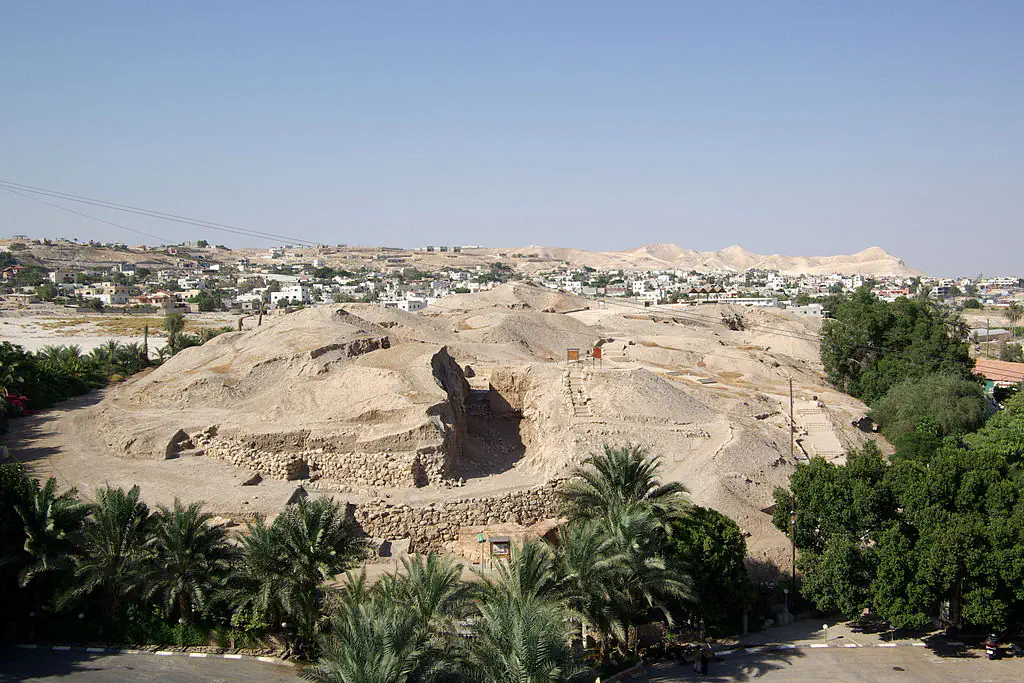
From Resurrection Life of Jesus Church
Jericho was an old city with a long history of habitation and long distance trade. We all know the history of the conquest of Jericho by the Hebrews as they entered the promised land. Archaeologists have not believed this account saying it was not possible as the city was already burned and destroyed prior to the Hebrews entry into Canaan.
Around 2300 BC, Jericho was occupied by the Amorites. About 1900 BC the site was occupied by the Canaanites and was a heavily fortified major city. It is this Amorite Canaanite Jericho that was encountered by the ancient Israelites in the Book of Joshua.
It is argued that Jericho was attacked and burned sometime in the middle or late Bronze Age between 1550 BC and 1400 BC. All the archaeologists agree that Jericho was destroyed in a violent, fiery destruction. The dispute lies in aligning dates for the Hebrews entry into the promised land. Jericho has been heavily studied for well over 100 years.
Jericho is a layered cake of remains of various occupations from about 10,500 BC to today. Each period has its own style of architecture, pottery, and living styles. It was destroyed and rebuild many times. The problem is identifying which layer is attributed to Joshua. Specifically city layer four or city layer five. The archaeologists are arguing over a something near a hundred years difference. Some argue the Exodus never happened.
Two Egyptologists, Kenneth Kitchen and James Hoffmeier have concluded that a close study of the Bible reveals that 480 years did not elapse from the Exodus to Solomon’s building of the Temple, instead almost 600 years elapsed putting the Exodus at 1540 BC instead of 1446 BC. This is certainly incorrect.
This has now been challenged by a compelling New Chronology brought forward by David Rohl. He is not a believer but he recognized the Bible as a historical work and believes that it should fit in the timeline instead of degrading the authenticity of the Bible. He said:
Is the Old Testament history or myth? The only way to answer that question is to investigate the biblical stories using the archaeological evidence, combined with a study of the ancient texts of the civilizations which had a role to play in the Bible story. But this has to be done with an open mind. In my view the biblical text – just like any other ancient document – should be treated as a potentially reliable historical source until it can be demonstrated to be otherwise.
David Rohl in The Lost Testament (2007)
The mainstream has not yet accepted this account although many are sympathetic to his work. Changing the accepted Egyptian chronology is heresy to many. What it does is cause a massive realignment of that period of history.
This new chronology relocates the Exodus to around 1460 BC. This would align the dates of the burning of Jericho. The archeologists are currently arguing over these issues.
Archaeological excavations at Tell es-Sultan, identified as ancient Jericho, have uncovered evidence of a destruction layer dated by consensus to the late Middle Bronze Age around 1550 BCE, featuring a collapsed mudbrick superstructure atop a stone revetment wall, deposited outward at its base, alongside a thick ash deposit indicating fiery conflagration. This destruction included rooms with fallen bricks, blackened floors, and large storage jars still filled with charred grain, suggesting an abrupt end.
Some archaeologists, such as Bryant Wood, have reanalyzed data to propose a Late Bronze Age I date around 1400 BCE based on pottery and other finds, arguing for alignment with biblical chronology, but this view is not accepted in mainstream scholarship. The chronological discrepancy has led many scholars to question the historicity of the conquest narrative as a literal event, viewing it instead as theological or etiological, though physical traces of collapse and conflagration remain subjects of interpretive debate.
Subtracting the 40 years of wandering in the wilderness from Rohl’s Exodus date of around 1446 BC puts the date at about 1406 BC in the spring since they celebrated Passover just before the conquest of Jericho.
Pottery is the telltale sign of which period a civilization is in as it changes over time much like our dishes have changed over time from our grandparents. The Middle Bronze Age account of 1540 BC is misrepresented in its lack of pottery findings while the later account of around 1406 BC has much better pottery findings.
One must understand that it is difficult to pin down ancient events that took place thousands of years ago. Many are squabbling over the difference of a hundred years or so over a 3500 year span. Many hate the word of the Lord and will do anything to discredit the Bible.
An expert on pottery named Bryant Wood, Professor of Near Eastern Studies has examined the site and has found the missing pottery the Kenyon excavation glossed over and misrepresented. The pottery styles claimed to have been missing by the Kenyon expedition have been found cementing the Late Bronze age fall of Jericho.
The city was burned with the storage jars full of wheat. Everything inside the city was cursed by the Lord except for the gold, silver, and the vessels of brass and iron. It was the first conquest into the promised land and it probably occured near the date of 1406 BC. Archaeologists found the storage jars full of wheat burnt in a massive fire. Most agree the walls fell flat. The only thing that was at issue among them was the date of the event.
In addition some some burial sites were dug up which found scarabs (amulets and impression seals) which bore symbols and pictures of Egyptian Kings. The latest of these kings was Amenhotep II, dating from 1413-1373 B.C. No evidence was found of burials after that time which leads one to conclude the city fell in that period and it aligns with the Late Bronze Age fall of Jericho, a city that had fallen and been rebuild several times in its history which leads to the confusion.
One of the first cities excavated in Israel was Jericho. German scholars Sellin and Watzinger dug at Jericho in the early 1900’s. In the 1930’s, British archaeologist John Garstang excavated at Jericho for several seasons. Garstang found local Canaanite pottery from the time of Joshua and evidence for a massive destruction of the city by a fierce fire which left ash deposits up to 3 feet thick. In addition to this, he discovered Egyptian scarabs in pit tombs outside of Jericho that also indicated the city was occupied down into the Late Bronze I period. This included a rare scarab of the much maligned Hatshepsut (ca. 1506/4-1488 B.C.), and a rare seal from the reign of Thutmosis III (1506-1452 BC). Garstang concluded that the evidence was consistent with an Israelite attack on the city around 1400 BC, the biblical date for the Conquest.
Researchers also found a part of the wall that did not fall that contained living quarters. This probably belonged to Rahab who lived in the wall and hid the spies.
17 And the city shall be accursed, even it, and all that are therein, to the Lord: only Rahab the harlot shall live, she and all that are with her in the house, because she hid the messengers that we sent.
18 And ye, in any wise keep yourselves from the accursed thing, lest ye make yourselves accursed, when ye take of the accursed thing, and make the camp of Israel a curse, and trouble it.
19 But all the silver, and gold, and vessels of brass and iron, are consecrated unto the Lord: they shall come into the treasury of the Lord.
20 So the people shouted when the priests blew with the trumpets: and it came to pass, when the people heard the sound of the trumpet, and the people shouted with a great shout, that the wall fell down flat, so that the people went up into the city, every man straight before him, and they took the city.
21 And they utterly destroyed all that was in the city, both man and woman, young and old, and ox, and sheep, and ass, with the edge of the sword.
22 But Joshua had said unto the two men that had spied out the country, Go into the harlot’s house, and bring out thence the woman, and all that she hath, as ye sware unto her.
23 And the young men that were spies went in, and brought out Rahab, and her father, and her mother, and her brethren, and all that she had; and they brought out all her kindred, and left them without the camp of Israel.
24 And they burnt the city with fire, and all that was therein: only the silver, and the gold, and the vessels of brass and of iron, they put into the treasury of the house of the Lord.
Joshua 6: 17-24
The video below gives a good view of the countervailing opinions and the evidence about how Jericho’s walls fell and how the Hebrews use the rubble to enter the city and burn it to the ground.
5 Every word of God is pure: he is a shield unto them that put their trust in him.
6 Add thou not unto his words, lest he reprove thee, and thou be found a liar.
Proverbs 30:4-5