Resurrection Life of Jesus Church
THE EARLY CHURCH
PART 9: SAUL THE PERSECUTOR
RLJ-2005
JOHN S. TORELL
MARCH 9, 2025
SAUL OF TARSUS
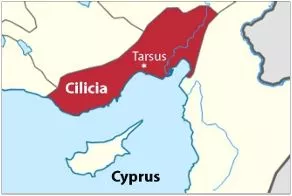
Rome sent Gnaeus Pompeius Magnus (Pompey) to defeat the Cilician pirates that were attacking and plundering ports and cities and disrupting trade in the Mediterranean. Pompey conquered Tarsus and made it the capital of Rome’s new province of Cilicia in 67 B.C. The city is located on the southern coastline of modern- day Turkey and lies northeast of Cyprus.
Saul was born to a Jewish family in the city of Tarsus. Saul’s Jewish parents possessed Roman citizenship and this why he was born as a citizen of Rome. It is estimated that his parents moved to Jerusalem with their children about A.D. 10 and Saul started his studies of the Old Testament under Rabbi Gamaliel as a teenager. Eventually he became a member of the Pharisees.
“I am verily a man which am a Jew, born in Tarsus, a city in Cilicia, yet brought up in this city at the feet of Gamaliel, and taught according to the perfect manner of the law of the fathers, and was zealous toward God, as ye all are this day.” (Acts 22:3)
“Though I might also have confidence in the flesh. If any other man thinketh that he hath whereof he might trust in the flesh, I more:
Circumcised the eighth day, of the stock of Israel, of the tribe of Benjamin, an Hebrew of the Hebrews; as touching the law, a Pharisee;
Concerning zeal, persecuting the church; touching the righteousness which is in the law, blameless.
But what things were gain to me, those I counted loss for Christ.” (Philippians 3:4-7)
Saul’s sister and her family lived in Jerusalem. Acts 23:16
It was common for Pharisees to be married. Perhaps Paul was a widower from earlier in life, but given his words about not being encumbered by marriage in his first letter to the church at Corinth, the apostle was clearly advocating the single life to fully serve God.
“But I speak this by permission, and not of commandment.
For I would that all men were even as I myself. But every man hath his proper gift of God, one after this manner, and another after that. I say therefore to the unmarried and widows, It is good for them if they abide even as I.” (1 Corinthians 7:6-8)
STEPHEN’S HEARING
Saul was present when the Sanhedrin heard Stephen speak and he was also in attendance at the deacon’s death. The stoning was the first salvo in the war against the Christians by the Jewish leadership. Acts 8:1
SCATTERING CHRISTIANS
The early church at Jerusalem numbered above 10,000 by this time and they had settled into communal living contrary to the command of Jesus, who had instructed them to spread out into the whole world and preach the Gospel.
“And Jesus came and spake unto them, saying, All power is given unto me in heaven and in earth.
Go ye therefore, and teach all nations, baptizing them in the name of the Father, and of the Son, and of the Holy Ghost:
Teaching them to observe all things whatsoever I have commanded you: and, lo, I am with you alway, even unto the end of the world. Amen.” (Matthew 28:18-20)
It is obvious that the apostolic leadership was in some kind of disarray. The general belief was that Jesus was returning very soon and therefore there was no need for long term plans; instead, they were content to visit the temple ground, preach, pray, and enjoy fellowship in the different homes of the commune. It was a blessing to have the gift of healing and see the church grow on a daily basis.
Persecution was the way that Jesus chose to move upon His church and cause them to spread out. History would reveal that the blood of the martyrs would be the seed of the church because persecution strengthens the body of Christ and serves as a testimony to onlookers. This is precisely what took place with Saul at the stoning of Stephen.
Jesus did not initiate the persecution, but He allowed the Devil to stir up the renegade Jewish leadership to a killing frenzy. Acts 8:3

The inquisition did not originate with the Roman Catholic church in 1542, but with the ungodly men who authorized Saul of Tarsus to wreak havoc upon the early church. Ironically, the Roman Catholic inquisition was established by Pope Paul III to counter the reformation begun by the Holy Spirit through the writings of Martin Luther.
SAUL’S PURPOSE
None of the apostles were Old Testament scholars. Their background varied as fishermen, a tax collector, and a zealot. They had been brought up in the synagogue system and possessed a basic understanding of the Old Testament.
Jesus wanted a man that had not only mastered the Old Testament, but was also knowledgeable of the Talmud and the Kabbalah. Saul of Tarsus became a Holy Spirit- filled theologian who would go on to produce masterpieces like the letters to the Romans and the Hebrews. The writings of Paul and the other apostles have kept the church of Jesus stable for the past 2,000 years.
God created Saul of Tarsus to be the instrument that scattered the early church, and after his conversion, he would go on to set forth the doctrine of Jesus that continues to the present day.
Jesus told Moses that Pharaoh existed for God to show His power to the Hebrews and the surrounding nations.
“And the LORD hardened the heart of Pharaoh, and he hearkened not unto them; as the LORD had spoken unto Moses.
And the LORD said unto Moses, Rise up early in the morning, and stand before Pharaoh, and say unto him, Thus saith the LORD God of the Hebrews, Let my people go, that they may serve me.
For I will at this time send all my plagues upon thine heart, and upon thy servants, and upon thy people; that thou mayest know that there is none like me in all the earth.
For now I will stretch out my hand, that I may smite thee and thy people with pestilence; and thou shalt be cut off from the earth.
And in very deed for this cause have I raised thee up, for to shew in thee my power; and that my name may be declared throughout all the earth.” (Exodus 9:12-16)
Paul understood this concept once he was born again; God will at times raise up someone so God can show His power in the destruction of that particular person.
“For he saith to Moses, I will have mercy on whom I will have mercy, and I will have compassion on whom I will have compassion.
So then it is not of him that willeth, nor of him that runneth, but of God that sheweth mercy.
For the scripture saith unto Pharaoh, Even for this same purpose have I raised thee up, that I might shew my power in thee, and that my name might be declared throughout all the earth.” (Romans 9:15-17)
In Saul’s case, Jesus had mercy upon him. After his conversion to Christ, Paul wrote that God had separated him to be His servant when he was still in the womb.
But when it pleased God, who separated me from my mother’s womb, and called me by his grace,
To reveal his Son in me, that I might preach him among the heathen; immediately I conferred not with flesh and blood: (Galatians 1:15-16)
THREE PHASES
God premeditated three phases for Saul’s life:
1. Become a scholar of the Old Testament.
2. Become a persecutor of the early church.
3. Be converted to Christ and set future doctrine for the church.
The third phase began on the road to Damascus. This was at least a year after Stephen’s death; maybe up to three years later. A number of Christian Jews fled to the city of Damascus, the old capital of Syria 168 miles to the north.
Saul had grand plans for the destruction of the Christians in Damascus. He was authorized by the Jewish leadership in Jerusalem and given a letter of introduction to the synagogues in Damascus that authorized him to arrest any Jew who converted to Christianity. The letter stated that they should be shackled and brought back to Jerusalem; it goes without saying that they would be tried, convicted and executed. Acts 9:1-2
SUMMARY
The story of Saul of Tarsus is something that few Christians have considered. How could the chief persecutor of the early church be a vessel of God? God obviously exists on a higher plane and does not think and operate like we do. This is the essence of the message to Isaiah around 700 B.C.
“For my thoughts are not your thoughts, neither are your ways my ways, saith the LORD.
For as the heavens are higher than the earth, so are my ways higher than your ways, and my thoughts than your thoughts.” (Isaiah 55:8-9)
The following events did not happen by chance:
1. The redemption of humanity was planned before the foundation of the world some time in eternity past.
2. The time period selected was when the Roman Empire was at its zenith and its excellent road system facilitated travel throughout the vast domain that spanned the Mediterranean Sea.
3. Mary and Joseph were placed in the timeline for the express purpose caring for Jesus.
4. The province of Galilee was chosen as a springboard to start Jesus’ ministry so that the God-man would have sufficient time to train the twelve apostles, the seventy others, and the thirty-nine women who were also part of the entourage.
5. The birth of the church was planned to take place exactly fifty days after the Passover, and for a while it prospered in Jerusalem, but then the disciples failed to follow the order of Jesus to go out into the world.
6. Saul of Tarsus was chosen to force the Christians to flee from Jerusalem and begin preaching the Gospel in other nations. Was this a painful experience for the Christians? Yes, and some of them were killed.
7. Once Saul had finished his assignment, he was knocked off his horse and challenged by the risen Messiah proclaimed by the early church! This confrontation saw him leave Satan’s team and become a convert of Jesus and a citizen in the Kingdom of God.
Remember, it’s not so important how you begin your life after salvation, but how you finish it!
Do you have an ear to hear with?