Resurrection Life of Jesus Church
THE EARLY CHURCH
PART 12: BREAKING AWAY FROM JUDAISM
RLJ-2008
JOHN S. TORELL
MARCH 30, 2025
THE CHURCH AT ANTIOCH
The question of whether Gentiles had a soul had been settled by the apostolic leadership with Peter’s testimony of what occurred at the house of Cornelius.
“When they heard these things, they held their peace, and glorified God, saying, Then hath God also to the Gentiles granted repentance unto life.” (Acts 11:18)
A great number of priests in and around Jerusalem accepted Jesus as the Messiah and were part of the early church.
“And the word of God increased; and the number of the disciples multiplied in Jerusalem greatly; and a great company of the priests were obedient to the faith.” (Acts 6:7)
After the stoning of Stephen, Christians were scattered and some of them went to Antioch where they established the first church outside of Jerusalem.
“Now they which were scattered abroad upon the persecution that arose about Stephen travelled as far as Phenice, and Cyprus, and Antioch, preaching the word to none but unto the Jews only.
And some of them were men of Cyprus and Cyrene, which, when they were come to Antioch, spake unto the Grecians, preaching the Lord Jesus.
And the hand of the Lord was with them: and a great number believed, and turned unto the Lord.” (Acts 11:19-21)
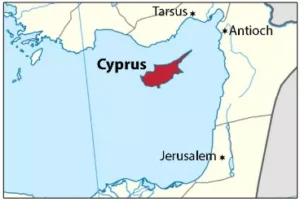
Barnabas was a main player in the early church. He was a Levite dwelling on the island of Cyprus, about 150 miles northwest of Jerusalem. The New Testament does not state if he was born in Judea, so more than likely he was a Jew whose family emigrated to Cyprus. We know he was wealthy since he was a landowner in the Jerusalem area.
His Hebrew name was “Joseph,” or “Joses” in Greek. Once he was born again, he became a member of the church in Jerusalem and the apostles renamed him “Barnabas.” He was known for his generosity and encouragement of believers.
“And Joses, who by the apostles was surnamed Barnabas, (which is, being interpreted, The son of consolation,) a Levite, and of the country of Cyprus,
Having land, sold it, and brought the money, and laid it at the apostles’ feet.” (Acts 4:36- 37)
The news that there was a vibrant church 414 miles north in Antioch eventually came to the attention of the apostolic leadership in Jerusalem and they sent Barnabas to check it out. He was well received and provided further instruction in the Lord, having been personally instructed by the apostles. Acts 11:22-24
Barnabas remembered Saul of Tarsus, and while the text does not explicitly state so, I believe the Holy Spirit told Barnabas to seek out Saul fifty miles to the northwest. The text says that he brought Saul to Antioch where the duo preached the Gospel. A number of Gentiles were saved and became members of the local church. verses 25- 26
The prophet Agabus visited Antioch and prophesied there would be famine throughout the world. The members of the church in Antioch took up a collection which they sent with Barnabas and Saul to Jerusalem. verses 28-30

We can establish a timeline for Barnabas and Saul in Antioch since there were multiple famines during the reign of Claudius Caesar from AD 41-54.
A second famine during the fourth year of Claudius’ reign persisted from AD 45-47 and greatly affected Judea. This was the event referenced by Agabus.
This means that Barnabas and Saul were in Antioch before AD 41, some eight years after the resurrection of Jesus.
CIRCUMCISION QUESTION
The church of Jesus was now open to all nations and more Gentiles continued to accept Jesus as their Lord and Savior. The word “messiah” did not mean anything to them because they had no background in Judaism; they were pagans who had come to God.
Luke does not reveal the identity of the Jews that arrived from Jerusalem pushing the issue of circumcision on the Gentiles at Antioch. Circumcision was a central part of Judaism because its observance maintained the covenantal relationship with God. It is likely these men were Pharisees who had accepted Jesus as the Messiah. Acts 15:1
This led to a heated debate between the newly arrived Jews and Paul and Barnabas, embroiling the local church, until it was decided to send a group to Jerusalem to receive clarification from the apostles. The church in Antioch paid for the trip. verses 2-3
The delegation was received by the apostles and the elders as they declared the great things that God was doing in Antioch. verse 4
The Christian Pharisees were not pleased with the way the delegation from Antioch was received and they voiced their displeasure that the Gentiles were not being circumcised. verse 5
This led to a heated debate that was going nowhere until Peter reminded the leadership that God had used him to declare the Gentiles were not animals as taught by the vile Talmud. They had value in God’s eyes, possessed a soul, and could be saved. The Holy Spirit was given to the Gentiles just like the Jews who placed their faith in Jesus. verses 6-9
Peter asked the assembly why they would put a burdensome yoke on the Gentiles with which the Jews also struggled. Acts 15:10
NEW BELIEF
Peter described the Christian faith based upon grace and faith in Jesus as the Messiah which leads to salvation. verse 11
The debate was effectively over. Paul and Barnabas were asked to share what God had done among the Gentiles. verse 12
Once they stopped speaking, James (the half-brother of Jesus) told the gathering how Simeon (Peter) had declared that God has opened the door to salvation for the Gentiles. verses 13-14
Peter’s testimony asserted that salvation and the baptism of the Holy Spirit had been bestowed unto the Gentiles and James stated this action was the fulfillment of prophecy. verses 15-16
“In that day will I raise up the tabernacle of David that is fallen, and close up the breaches thereof; and I will raise up his ruins, and I will build it as in the days of old:
That they may possess the remnant of Edom, and of all the heathen, which are called by my name, saith the LORD that doeth this.” (Amos 9:11-12)
Those who are not Jews will receive favor when they call upon the God who knows the future and has a far-seeing plan that is being worked out. Acts 15:17-18
JAMES’ DOCTRINE
James set forth a doctrine that proposed Gentiles abstain from pollutions of idols, fornication, things strangled, and from blood. verses 19-20
The fact that this admonition omitted most of the Mosaic law came down to expediency since there were synagogues in most cities where there was a Jewish population and they read from the Torah and could explain it to the Gentiles. verse 21
The apostolic leadership and the church members in Jerusalem felt this was an excellent idea and a letter was drafted to the churches in Antioch and Cilicia. verse 22
It is noteworthy that James and the rest of the group did not quote Jesus. The four Gospels were not yet written, and while the original eleven apostles were present, not one of them thought to reiterate the great commission.
As a half-brother to Jesus, James had not been part of Jesus’ ministry prior to the crucifixion, but he became the leader of the church in Jerusalem when the apostles left on missionary trips and never returned.
The drafted letters acknowledged that certain unauthorized Jews had created strife by advocating circumcision and keeping the Mosaic law. verses 23-24
The leadership in Jerusalem had chosen Barnabas and Paul to deliver the letter. In addition, Judas and Silas were being sent as independent witnesses to verbally corroborate the details of the letter. verses 25-27
The letter ended with a repeat of what James had stated earlier to abstain from meat offered to idols, blood, things strangled, and fornication. The apostles did not come to this conclusion because the Holy Spirit said so. The third person of the Godhead was conspicuously absent during this assembly, but the leadership wanted to convey that they were under the influence and direction of the Holy Spirit. They wanted the recipients of the letters to know just how they had come to this conclusion. verses 28- 29
The apostolic leadership had established two important doctrines:
1. Gentiles are people and can be saved.
2. It was no longer necessary for males to be circumcised to be saved.
FOUR GOSPELS
When were the four Gospels written? It is obvious that they did not exist when the apostolic leadership concluded that Gentiles had souls and wrestled over whether they should be circumcised.
As the writer of the Book of Acts, Luke did not refer to his Gospel in this account. He ends the narrative with Paul being imprisoned in Rome. We know that Emperor Nero ordered Paul’s execution and he reigned from AD 54-68. Scholars have put Paul’s death to around AD 64/65.
We know that the war between the Romans and the Jews began in AD 67 and ended with the destruction of Jerusalem and the temple in AD 70 just as Jesus predicted. This tells us that the four Gospels were written before this conflict, somewhere between AD 40 to 65.
CHURCH DOCTRINE
The doctrine of the church should not be taken solely from the Book of Acts, but from the entire New Testament. The teaching of Jesus should assert eminence over the decisions the apostles made after the God-man’s resurrection. The Son of God’s teachings were a mixture of the Torah and new commandments. Jesus made it clear that He had not come to destroy the Torah or the Prophets, but to fulfil them.
This fulfilment came into being when Jesus became the final sacrifice, effectively putting an end to the sacrificial part of the Mosaic law.
“Think not that I am come to destroy the law, or the prophets: I am not come to destroy, but to fulfil.
For verily I say unto you, Till heaven and earth pass, one jot or one tittle shall in no wise pass from the law, till all be fulfilled.
Whosoever therefore shall break one of these least commandments, and shall teach men so, he shall be called the least in the kingdom of heaven: but whosoever shall do and teach them, the same shall be called great in the kingdom of heaven.” (Matthew 5:17-19)
When the apostolic leadership set forth doctrine about food and circumcision, they believed the second return of Jesus was imminent and the church age was just for a short time. There were no plans being made for the future. The apostles could not imagine that Jesus still had not returned after 2,000 years.
We would do well to heed the words of Jesus:
“If ye love me, keep my commandments.” (John 14:15)
1. Dilling, Elizabeth: THE JEWISH RELIGION – ITS INFLUENCE TODAY, The Noontide Press, 1983,
pp.16-17
Remember, it’s not so important how you begin your life after salvation, but how you finish it!
Do you have an ear to hear with?